
Colearning Spaces
Convivial Places of Learning
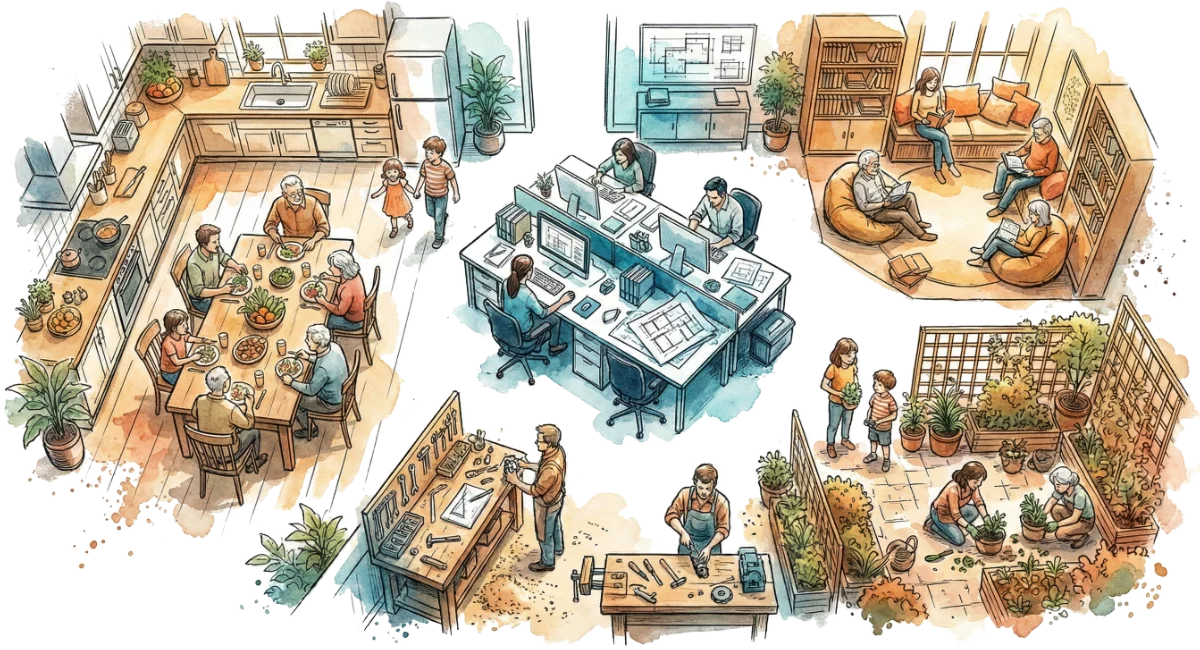
The physical space fosters encounter. In our vision, we speak of convivial places. Here we draw on a term from Ivan Illich. Illich distinguishes between manipulative institutions (like traditional schools), which turn people into passive consumers of curricula, and convivial places.
A convivial place of learning is an open workshop, a library, a marketplace in a neighborhood center, or a park: The place doesn't prescribe what you should do. It empowers you.
A good Colearning Space is characterized by three properties:
- Accessibility: No barriers through certificates or age. The place is open to everyone who wants to do and learn something ("Access before Efficiency").
- Configurability: The space is not statically finished. The Colearners can change it, move furniture, paint walls, use tools. We are not inmates of the space, but its shapers. Everywhere there are materials that have no fixed function, but invite play and creativity (affordance).
- Encounters: The architecture fosters community: It creates permeable zones that make random encounters and exchange between generations and fields of activity inevitable.
Such places become greenhouses for autonomy, inviting the step from consumption to one's own creation.
Fertile Ground: Docking Instead of Building New
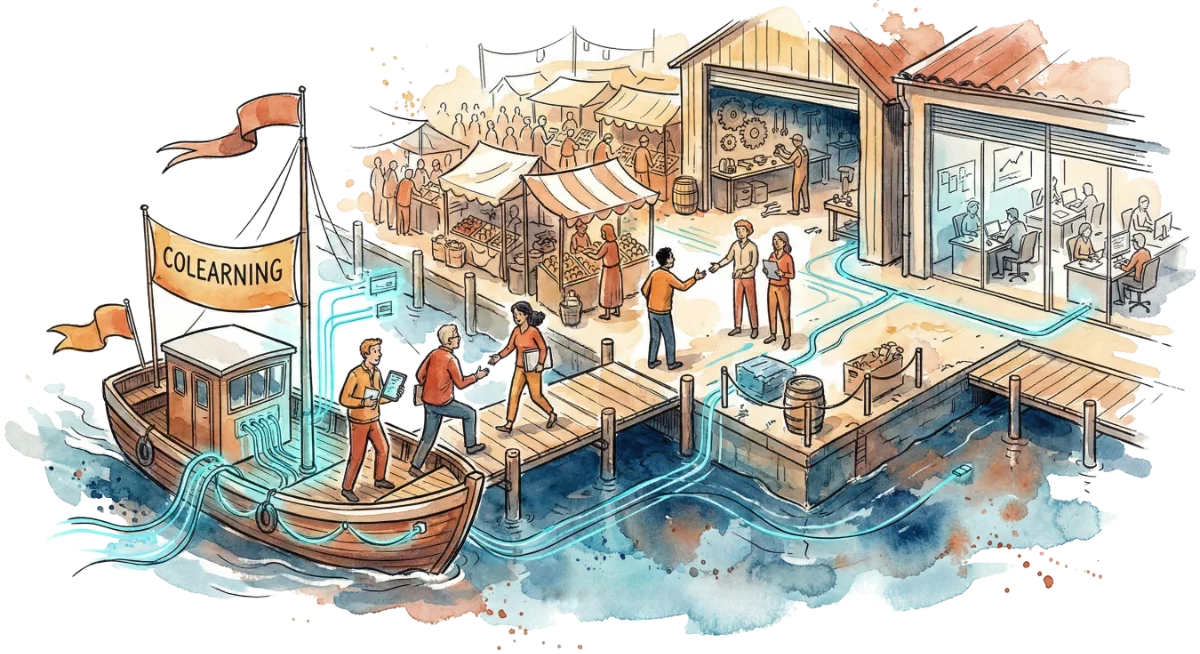
We don't have to build new "cathedrals of learning." An isolated Colearning Space that must produce everything itself has a hard time. But our cities and villages are full of places where life is already pulsing – we call this fertile ground.
Colearning's strategy is not isolation, but docking. We go to places that produce "waste heat." By "waste heat," we mean real life, real work, and real problems that are happening there anyway. Colearning inserts itself incidentally into these processes: We use the existing infrastructure, machines, and experts to enable learning as a byproduct.
Learning Landscape Map: Opening Up Villages and Cities
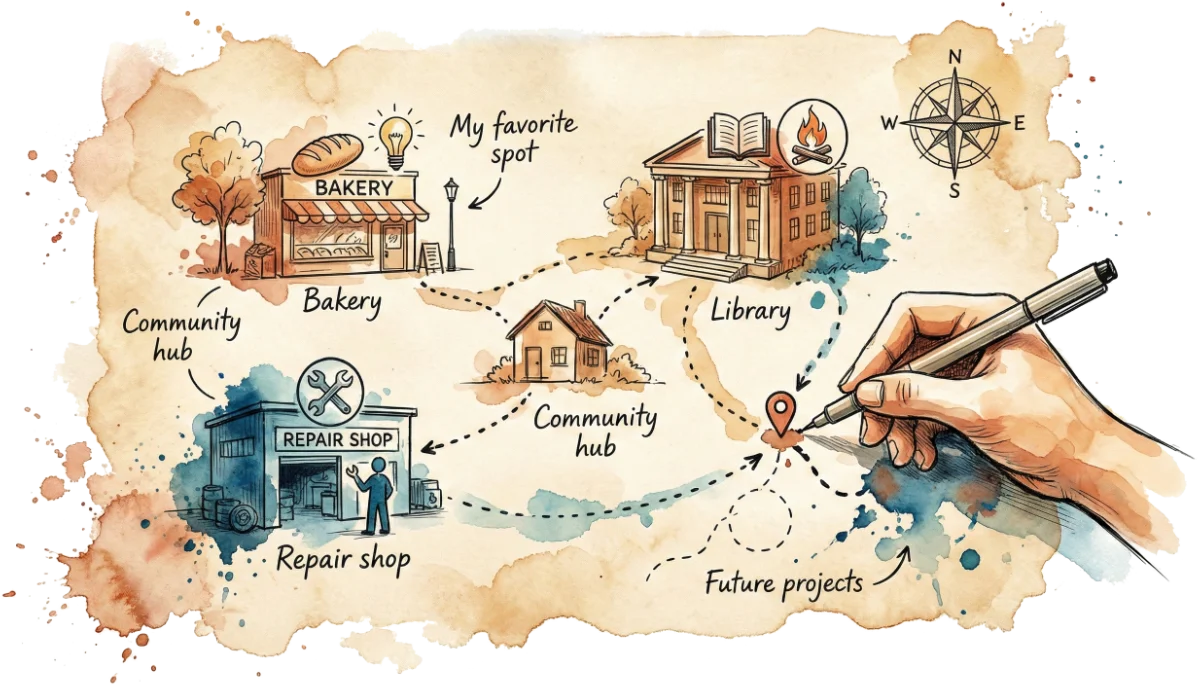
The path begins with what we already have in the environment. It's best to embark on a curious treasure hunt ("Asset Mapping") with very different people of all ages:
Where is something interesting happening? Where are curiosities and peculiarities? Where is there waste heat? Where is there unused infrastructure? Where are gaps, where is the local community missing something? Where are exciting people you could accompany in their profession ("Observing")? Where could we contribute something ("Pitching in")?
The architect Danish Kurani calls this process the identification of "Community Assets." For him, physical space is only effective when it activates the already existing, often hidden treasures – talents, tools, or unused spaces – of a neighborhood, rather than ignoring them.
Ideal docking points for this treasure hunt are:
- Coworking Spaces: Here the infrastructure and working world are already on site. We can bring in radical age-mixing and conscious learning. → Story: Colearning Bern
- Museums & Libraries: Places of knowledge that can transform from archives to living third places.
- Multigenerational Houses & Clubs: Here experience and time await the curiosity of youth. Existing social networks that can be enlivened through new learning formats.
- SMEs & Workshops: Real machines and real professionals are the best learning environment.
- Market in the Village or Neighborhood: At the market, you can offer something yourself or find people you'd like to learn from.
From this emerge Learning Landscape Maps (a term coined in the "Urban Villages" initiative). We create a physical or digital map that makes these places visible and connects them. Thus the village or neighborhood transforms from a collection of isolated buildings into a coherent ecosystem where learning is possible everywhere.
We bring Colearning to all possible and unexpected places. Colearning shouldn't create separate islands, but connect worlds and open doors for a new culture of living, working, and learning.
Further Reading & Sources
- Ivan Illich: Tools for Conviviality (on the difference between industrial and convivial tools).
- Ivan Illich: Deschooling Society (Critique of the institutionalization of learning).
- Urban Villages: Learning Landscape Maps (Concept for visualizing learning places in the neighborhood).
- Danish Kurani: Community-Driven Design and the Concept of Asset Mapping (on designing learning spaces that activate local resources instead of isolating them; cf. kurani.us).
- Loris Malaguzzi: The concept of "space as the third educator" from Reggio pedagogy.
- James J. Gibson: The Theory of Affordances (Environmental psychology).