
CAMPFIRE: Understanding & Distilling
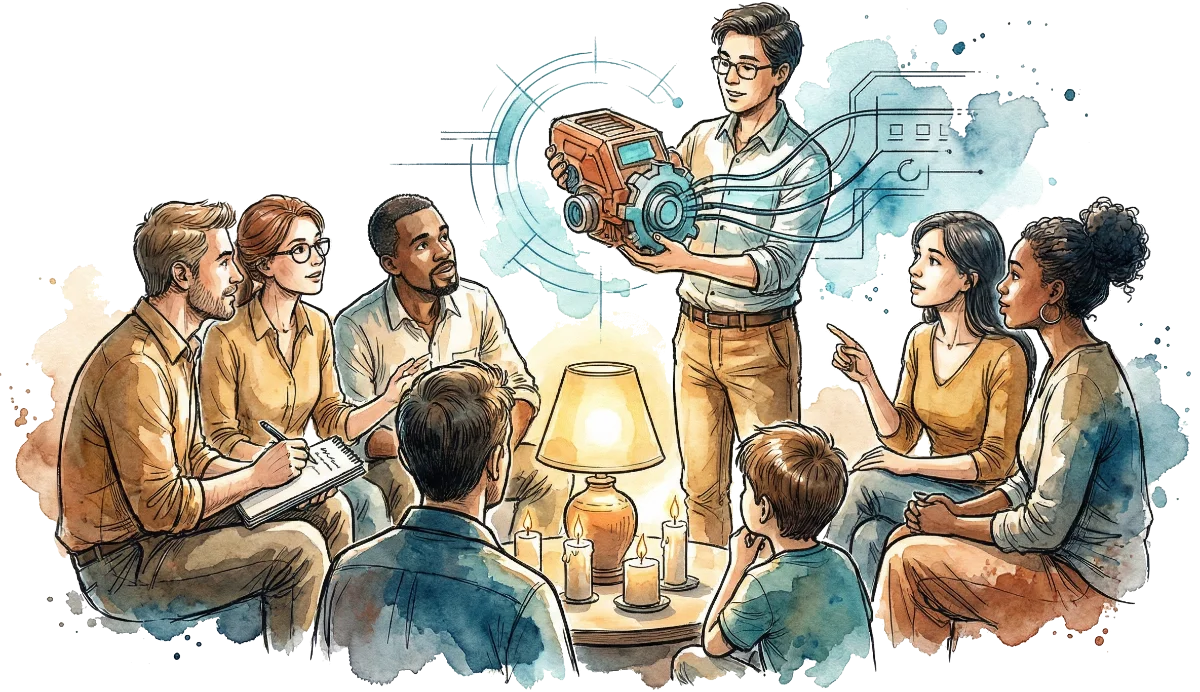
Core Statement: "I pass it on."
At the Campfire, the often wild, chaotic experience of the Hunt becomes something that holds:
Patterns, stories, tools. We are social beings – therefore learning is never just private. Those who learn change the Tribe: by making visible what worked and what hurt (Bounty and Learning Treasures), by naming, asking, organizing, documenting, and passing on. Thus the circle closes: From individual effort comes collective competence – a commons that makes the next Hunt easier, braver, and wiser.
Pull Principle: Theory on Demand
Learning along a curriculum is often learning in advance – hoping to need it later (just-in-case). We reverse this: At the Campfire, we learn "just-in-time." A problem in the Hunt creates an emotional and cognitive pull: We need a solution now. Theory here is not an end in itself, but the missing tool to save the project. Knowledge absorbed at the moment of necessity anchors deeper because it's immediately applied.
But at the Campfire, you never learn alone. When someone "pulls" a solution, those sitting around benefit through legitimate eavesdropping (Legitimate Peripheral Participation). Knowledge diffuses incidentally into the group – like warmth that reaches everyone, even those who didn't just add wood. Thus the individual solution becomes a collective treasure.
What we live digitally and on-site in Colearning today, Ivan Illich already sketched in 1971 as "Learning Webs." Instead of a curriculum that makes everyone the same, he called for networks that connect learners with the resources (things, peers, mentors) they need right now for their current challenge. The Campfire is where this matching happens.
AI as Reflector
At the Campfire, AI changes its role. Where it was an accomplice during the Hunt, here it becomes reflector and archivist. It helps structure chaotic experiences, recognize patterns, and prepare reports for the Digital Garden. It doesn't replace thinking, but accelerates the distillation of experience into insight.
Typical Tools at the Campfire
- Treasure Sharing: This is the central community ritual. We come together physically to share yields (money, products) and insights (mistakes, learnings). Without Treasure Sharing, the Hunt remains private; with it, it becomes a commons.
- Digital Garden: What is told at the Campfire fades. In the Digital Garden, we write it down. We make learning permanently visible ("Show your work") so others can benefit from it asynchronously.
- Mentoring: Mentoring also plays a role here, this time retrospectively: "What did you learn from that situation?"
Anti-Patterns: When the Fire Goes Out
Knowledge must flow. The Campfire must not become a place of vanity or information overload.
| Anti-Pattern | Description | Check / Remedy |
|---|---|---|
| Bulimic Learning | Knowledge is crammed in "just-in-case" (lectures, workshops) without an acute application in the Hunt. | Check: What do we need this for this week? Action: Cut input if no pull moment exists. |
| Showcase Without Substance | Only highlights are presented ("Instagram reality"). Mistakes are hidden. | Check: Do we also show difficulties, dead ends, and defeats? Action: Model sharing failures. Introduce playful elements like "Failure of the Month." |
| Bounty as Possession | Insights, (financial) yields, or project results are hoarded or privatized. | Check: Is the bounty (or at least parts of it) shared with the community (transfer to the commons)? Action: Apply transparency ritual (e.g., "lifting the veil"). |
Further Reading & Sources
- Ivan Illich: Deschooling Society (Concept of "Learning Webs": Self-directed access to things, skills, and like-minded people).
- Gerhard Wohland: Thinking Tools for High Performers (Knowledge vs. Capability).
- Jean Lave & Etienne Wenger: Situated Learning: Legitimate Peripheral Participation (The concept of learning by simply being present at the edge of a community).
- Taiichi Ohno: Toyota Production System (Origin of the Pull Principle).