
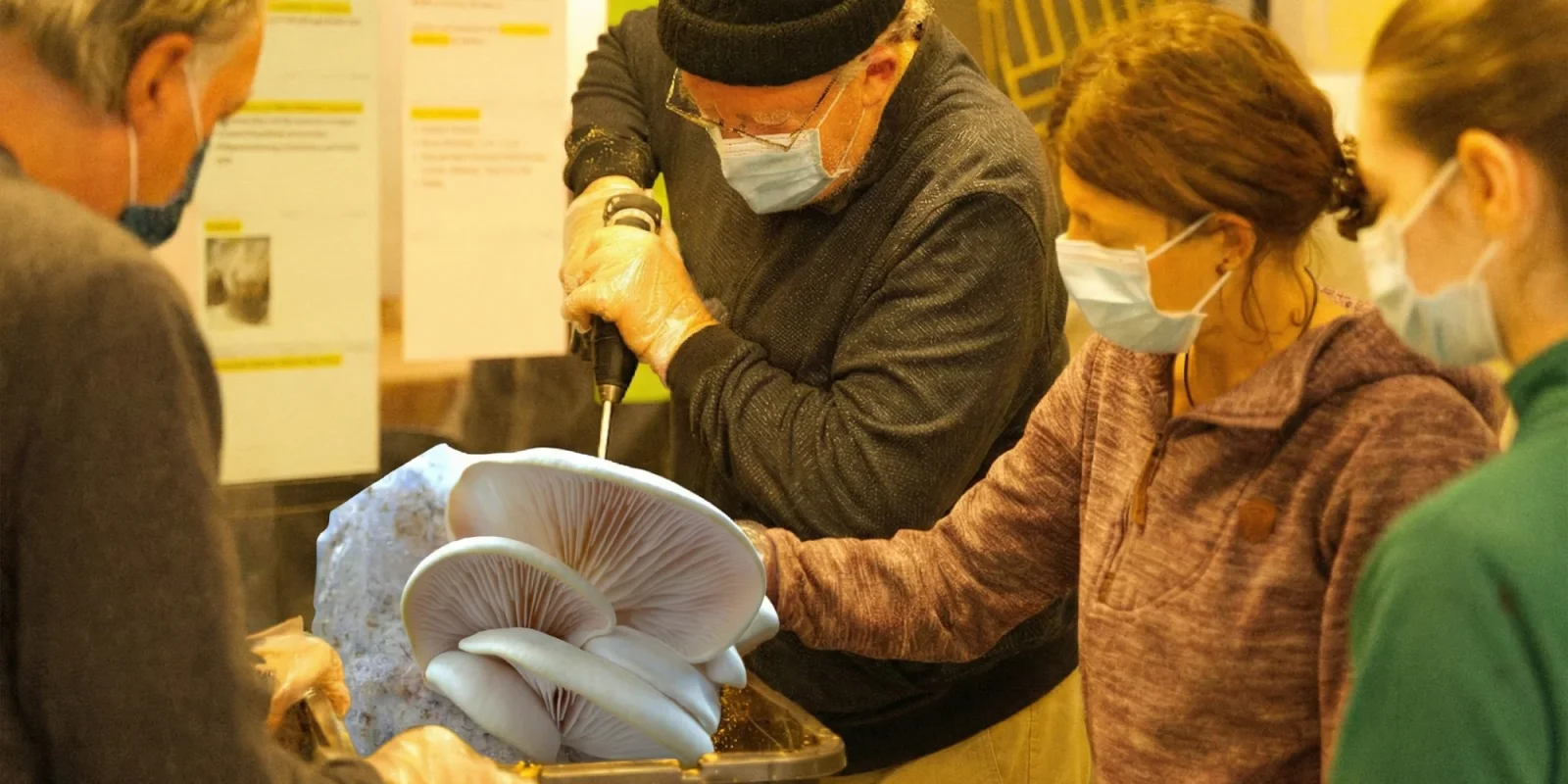
The Mushroom Farm Bern was the first learning enterprise of Colearning Bern. A radically mixed-age team (10 to 77 years) builds a farm for edible mushrooms in the basement of the coworking space, in the middle of the city. Used coffee grounds from the coffee bar serve as raw material, mixed with sawdust – turning waste into value. The goal is to sustainably grow and sell gourmet mushrooms. In doing so, participants create an authentic learning lab: No one on the team is a mushroom cultivation expert; everyone learns everything together from the ground up, through the practical founding and running of a real business. Real responsibility is on the agenda from the start, with real risk and real feedback. So it quickly becomes clear what previously sounded abstract: If the humidity isn't right, the mushrooms die. If no one does marketing, no one buys our products. There's no teacher, no grades – reality gives direct feedback.
Hunt: The Harvest Crisis
At first, everything goes according to plan. The first mushrooms grow, motivation is high. But after a few months, reality strikes: The harvest collapses, mold threatens the mushroom cultures. Suddenly, mere "observing and pitching in" (LOPI) is no longer enough. A serious crisis with real financial and material pressure. Nature as an incorruptible feedback-giver posed the question to the team: Do we give up or grow from the challenge?
Campfire: The Turning Point
The crisis creates a massive pull effect for abstract knowledge (instead of something being "pushed" beforehand "just in case"). Suddenly, everyone has to learn about mushroom spores, hygiene, and microclimate – and immediately. Biology, chemistry, physics are acquired at lightning speed because the survival of the mushroom farm depends on it. An external biologist and mushroom expert is brought in as an accomplice to help with the analysis. In joint campfire rounds, new knowledge is discussed and directly applied practically: The team installs additional sensors, adjusts the ventilation, changes the substrate. This "just-in-time" learning process saves the production.
Bounty
Overcoming the crisis gives the colearners an enormous competency boost. Within a few weeks, all participants learn far more than months of courses could ever have conveyed. They have, for example, worked scientifically (collected data, measured pH values, consulted external literature), learned organizationally (called emergency meetings, clarified decision structures, redistributed tasks), and acted entrepreneurially (informed customers, adapted products, adjusted marketing strategies). Intensive social learning also took place: Young and old worked together on solutions, no one was excluded – on the contrary, every skill found use somewhere. In the end, the team agrees: Even if the mushroom farm were to fail as a business, the learning was already a success. The learning gain is so overwhelming that the project can actually no longer fail. In fact, they subsequently succeed in not only stabilizing the mushroom farm but repeatedly harvesting mushrooms, producing mushroom boxes for home, and selling them to enthusiastic customers. The learning enterprise lives on – and has delivered double returns: financial profit and invaluable shared learning experiences.
Replication
The concept of the mushroom farm can in principle be implemented in other contexts as well. Mushrooms grow on various organic wastes, whether in the city or in the countryside. Here, circular economy and education combine ideally. Anyone wanting to start a similar learning enterprise can draw on models like the Mushroom Farm Bern – the team is happy to share their experiences with interested parties.