
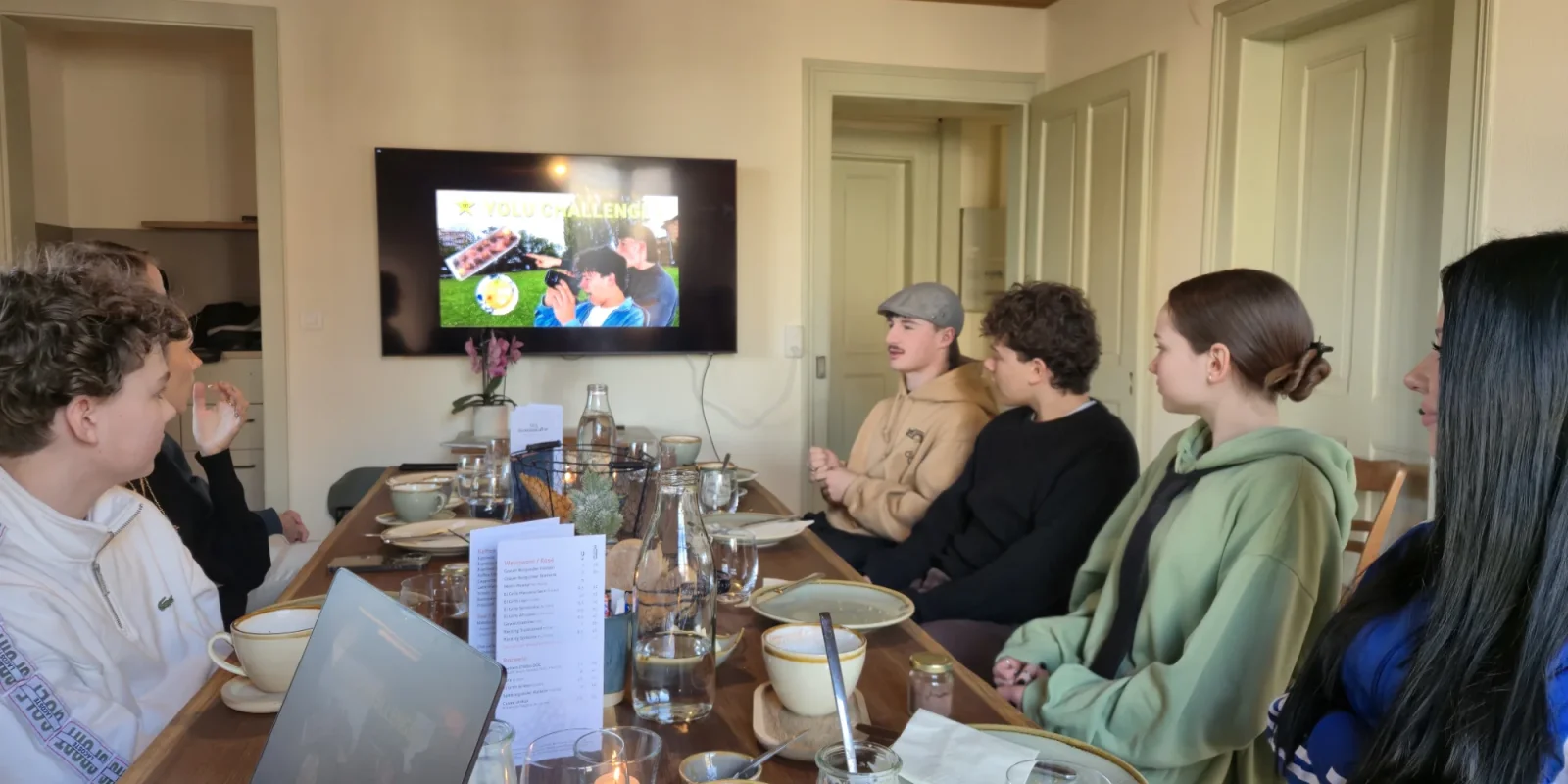
YOLU is a newly founded company that transfers Colearning principles to vocational training. Several small companies from the Effinger community have joined together to enable learners, under the umbrella of YOLU, an entrepreneurial, self-directed vocational training in the field of media technology (IT/media). The result is junior teams that operate like internal startups and execute real customer orders – from web design to video production to building and operating their own video podcast studio. In many training companies, learners are only entrusted with small partial tasks on customer orders and are often shielded from customers and the market. At YOLU, they're at the very front and execute projects from A (like Acquisition) to Z (like invoicing) themselves. Of course, this is only possible because they're embedded in a community (Tribe) and have access at any time to experienced juniors and seniors with lots of life and work experience.
Challenge
Implementing such a novel training brings various hurdles. Institutionally, YOLU must meet the formal requirements of vocational training in Switzerland while preserving the flexibility of Colearning. This means that several companies, partner businesses, and subject experts coordinate to take on the role of training companies – a novelty that requires both coordination with authorities and great trust from all involved. Everyone is challenged to maintain together as large a space as possible for the juniors' self-determination. For the juniors themselves, this path means more freedom and more responsibility: Without a single fixed trainer dictating every step, they must become active shapers of their own training path. This proves particularly challenging when the abilities for creative problem-solving and taking responsibility have atrophied through many years of schooling.
Solution
YOLU was implemented with clear agreements and much community spirit. A few entrepreneurs from the community joined together, sought accomplices and partner businesses. YOLU was founded as a company in Steward Ownership, so that juniors can, after a probation period, take over the steering wheel of YOLU together with the others. The YOLU team organizes itself largely agilely: In stand-up meetings, progress is discussed and roles defined. As is usual in Colearning, all juniors have regular 1:1 mentoring. All receive 20% of their work time for free use on their own learning projects and maintaining their public portfolio (Lilo.page). This makes the projects and learning visible – both for the juniors themselves and for the community. Additionally, artifacts emerge for developing lifelong "portfolio careers," which is often more valuable and meaningful than school certificates or credentials. Central is that the juniors learn to be entrepreneurs in their own learning process, that is, proactive "CEOs" of their own educational biography. One mentor described it this way: "Learning entrepreneurs don't wait for tasks, but actively seek relevant problems that need to be solved." That's exactly what the junior media technologists at YOLU do: When there's no external customer order pending, they define their own projects and make themselves useful in the community or at partner businesses.
Impact
The result of this new vocational training is impressive. For the young people, training transforms from an externally controlled obligation into an adventure of self-development. They take responsibility for themselves, for others, and for the shared enterprise. They report that they gain enormous self-confidence in a short time – they're perceived as equal colleagues in everyday work, their ideas really count. One of the juniors said: "In school, I would never have learned to lead a meeting with customers. Here I had it down in three months." In fact, the YOLU team independently takes on customer projects and successfully completes them. Juniors experience failures and successes: satisfied customers and occasionally dissatisfied ones, a successful podcast production, a website that goes live – immediate effects. This boosts motivation and is a natural learning turbo.
For the partner companies, participation also pays off: They get access to engaged young talent without any one company having to bear the full responsibility and administration for the training alone. Additionally, the juniors bring fresh wind and new perspectives to the businesses.
At the system level, this story also attracts attention from education innovators and policymakers: YOLU demonstrates a solution for how vocational training can mesh with principles of entrepreneurship and self-directed learning. And this with extremely high flexibility that also enables young people with different abilities and needs (e.g., neurodiversity, school trauma, etc.) a solid training path. Additionally, a tight labor market responds very positively to these career paths, while standardized degrees become mass commodities and lose relevance. Those who want can still obtain recognized degrees – and simultaneously develop competencies far beyond any curriculum (entrepreneurship, team leadership, self-reflection).
This leads to a central insight: Potential development beats norm fulfillment. When young people are given spaces to try out their potential in real tasks, they fulfill the required norms (exams, degrees) almost incidentally – often even better than on the traditional path. YOLU and learning enterprises thus underpin the vision of dynamics-robust education: young people are empowered to master unforeseen challenges in a dynamic world because they've already learned during their training to act autonomously and think in networks.
What Can Others Take Away?
YOLU shows that even in the regulated field of vocational training, there is room for innovation (and need for innovation). Instead of despairing at existing structures, one can create consortium solutions: Why not bring together several small businesses, coworking spaces, or public institutions to jointly handle training phases? Important is to provide network infrastructure (task pool, mentor pool, community meetings) and involve the formal bodies if possible – then an official training program can also be redesigned. Additionally, it's crucial to make learning progress and project results visible, rather than thinking in grades and intermediate exams. Transparency about actual skills (e.g., via a portfolio website and digital badges) ultimately also convinces employers and schools or helps in building one's own self-employment. So it becomes clear: What counts is not working through a curriculum, but the connectable competency that someone builds in real projects and makes visible to the outside.