
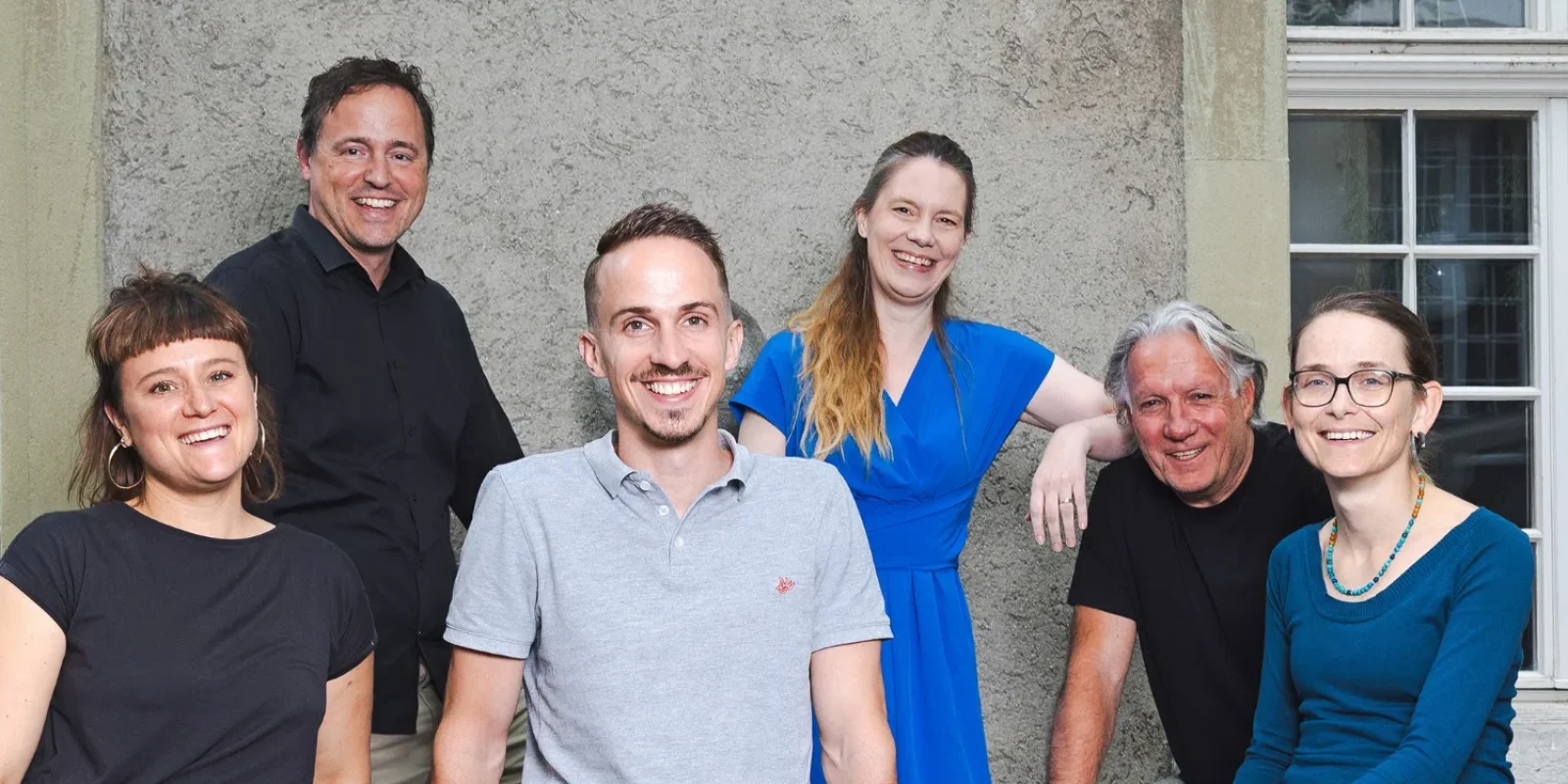
The Urban Village Webergut in Zollikofen near Bern shows Colearning in the dimension of housing. In a former office building, the cooperative Urbane Dörfer is developing an urban village that integrates living, working, and learning. Here, a place is taking shape with fluid transitions between private apartments, semi-public communal areas, and publicly accessible spaces. The ground floor – the commons – houses coworking spaces, workshops, studios, and communal kitchens, naturally fostering encounters between residents of all generations.
Challenge
Conventional living and education concepts separate strictly: Here the home, there the school; here the family, there the institution. The Webergut counters the pedagogical special world of school with permeability and encounter as the default. The problem it addresses is the isolation of learning from real life. The Webergut asks: How can we design a residential neighborhood so that everyday learning for all generations becomes the norm rather than the exception?
Mechanisms (Framework Levers)
At Webergut, several Colearning principles are anchored architecturally and socially:
- Permeability: There is no sharp separation of private vs. public. The commons zones on the ground floor are semi-public spaces that serve both the neighborhood and the residents equally. Workshop, coworking, kitchen – all these areas are learning and encounter spaces that one can stumble into at any time. Learning thereby becomes ubiquitous because work and everyday life visibly take place.
- Generation Mixing as Learning Field: The Webergut fosters intergenerational living, where young and old come into contact. Whether in the community garden or the woodworking shop – opportunities arise for knowledge, stories, and craft traditions to flow between generations. This reactivates the Ballenberg Principle, where cultural knowledge and skills are passed on as a "backup" from one generation to the next. What was once normal in village life is here consciously restaged.
- Pioneer Use & Prototyping: Even before the renovation phase, the building was temporarily used as a real-world lab. Instead of waiting for the perfect final buildout, the community started in the "unfinished" with interim uses – workshops, pop-up studios, educational offerings. This experimental phase made it possible to develop a learning and neighborhood culture before the apartments were even occupied. The motto: first do, then build. This way, feedback from practice flowed directly into planning the final concept.
Effects & Bounty
The Webergut demonstrates what education integrated into everyday life can look like. The residents – whether 5 or 85 years old – constantly learn from each other: in the course of daily life, recipes, craft tricks, digital skills, and gardening tips are exchanged. The Webergut thus normalizes the informal, neighborly learning that has often been lost in anonymous urban settings. The bounty here is an inclusive sense of community and mutual everyday support – the kind otherwise only found in the proverbial "village." For education innovators, the Webergut is important proof: it shows that learning spaces can be created through architecture and infrastructure without needing "classrooms" – the neighborhood is the curriculum. The structural integration of learning into housing creates resilient communities where knowledge becomes commons: accessible to all, co-shaped by all.
Transferability
Projects like the Webergut can be envisioned wherever new forms of housing or neighborhood centers emerge. One key is to plan commons zones – shared spaces such as community rooms, workshops, co-offices, and gardens. Another key is to plan for social diversity – avoiding age segregation and instead creating mini-"villages." And on a practical level: even before such a place is fully built out, interim uses can serve as prototypes – a temporary coworking or culture space can help shape the community that will later sustain the place.