
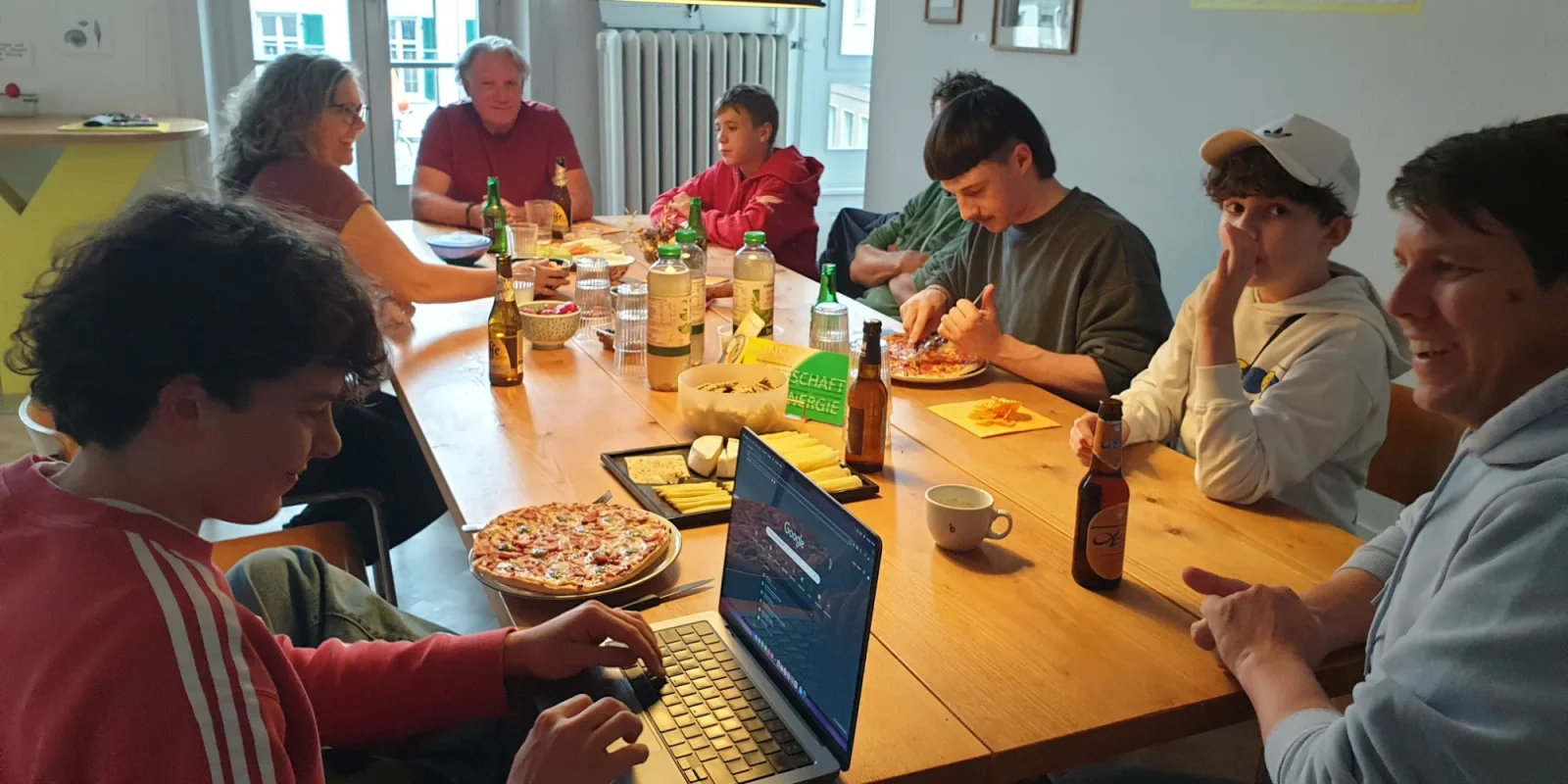
In 2019, an experiment began at Effinger, a coworking space in Bern: Colearning Bern – a meeting point where working and learning merge. Anyone walking through Effinger on an ordinary day would see nothing unusual at first: people working on laptops, discussing, drinking coffee. But in the midst of it there are also learners, children, teenagers, and adults. They don't sit in separate classrooms but work on their own questions and projects – right in the middle of the coworking community.
Colearning Bern was carried from the beginning by the vision: "We bring the worlds of work and learning together. We create a space where people of all ages meet in meaningful work and curious learning."
This creates a permeable place where learning and working no longer appear as opposites, but as two expressions of an active, self-determined life.
The Challenge
Creating such a space meant entering new territory. There was neither a ready-made concept nor official permission – instead, courage and a spirit of experimentation shaped the start. The founders didn't want to stop at thinking, but to take action. The central challenge is cultural: overcoming traditional boundaries. How do you connect teenagers who have left school or never attended with adults seeking new forms of work and learning? How does a community emerge without the usual hierarchies of teachers and students? And would a coworking space even allow children and teenagers to become part of everyday work life?
Solution: Tribe → Hunt → Campfire
Colearning Bern began as a living experiment that continues to grow to this day (early 2026). Carried by the motto "Just start!", spaces were opened, structures loosened, and people of all age groups invited to participate. The Tribe – the social foundation – is the existing Effinger coworking community: an open community of freelancers, creatives, and teams with openness to new ideas. This "fertile ground" proves decisive: A vibrant social space makes starting much easier. The coworkers trust in experimentation and are ready to share responsibility. Thus, young colearners are accepted as full members from the start, rather than being seen as outsiders. They work on their own projects at eye level with adults – whether programming, making videos, crafting, or organizing. Adults, in turn, don't just act as mentors but make their own learning visible and serve as partners and accomplices.
Much emerges spontaneously: first "learning fields" are identified, from permaculture on the terrace to media production in the film studio. A central element are the shared breaks – with coffee, hot chocolate, and during lunch. These often feel like a gathering around the campfire. Countless conversations about the hunt (work and learning projects) take place. There's hardly a topic that isn't discussed. Even 14-year-old teenagers start getting interested in topics like retirement planning when that happens to be current among adults.
The decisive mechanism in Bern is not a rigid program, but the permeability of space and culture: Learning takes place in the midst of work reality because encounter is architecturally and culturally possible. Colearning Bern thus exemplarily united the elements of Tribe–Hunt–Campfire in one setting: A communal tribe (coworking community) forms the ground, real projects and responsibilities drive the hunt, and reflective campfire rounds ensure meaning-coupling and course correction. Routines for reflection and consolidation are established: daily check-ins, brief mentoring conversations, and regular treasure sharing events to which coworkers and guests are also invited. These rituals anchor learning socially and ensure visibility.
Colearning Bern thus develops step by step, carried by the motto: "We just did it. And we're still doing it. Because: We're still learning!"
Impact & Validation: The Diversity of Paths
What began as an experiment has proven to be a highly effective incubator for life paths. The biographies emerging from Colearning Bern are characterized by great diversity and connectivity.
It shows that the competencies acquired here – self-direction, problem-solving, and networking – are in demand in almost every field. The colearners today cover a broad spectrum of career paths:
- Crafts & Practice: Some find classic apprenticeships, often thanks to their exciting project portfolio. They complete vocational training from winemaker to media technologist to librarian to bicycle mechanic.
- Technology & Media: Others start careers in the digital field – first experiences at Effinger lead to training and jobs as IT specialists or video producers.
- Academic Connections: For some, the path leads back to formal education – whether at a high school, a university of applied sciences, or a university. Degrees are obtained, conventionally or sometimes unconventionally. For example, the Swiss Matura through self-study or a remote degree from an American high school are included.
- Career Change & Transformation: Colearning also enables radical new beginnings. For example, a trained nurse switches to illustration & graphics, a photographer to video production, or a retail employee to personnel and organizational development.
- Entrepreneurship & Leadership: Many Colearning alumni start their own businesses (in art, tech, or services), become self-employed coaches, or take on leadership responsibility in team and learning development at larger institutions.
- Personal Development & Life Design: Colearning creates the opportunity to engage with life questions and personal projects well into old age and bring them into exchange (lifelong learning).
This abundance of paths shows: Colearning doesn't produce standardized CVs, but resilient personalities who find their place in the world and continue to grow as learners throughout their lives.
Lessons Learned
From the story of Colearning Bern, several conclusions can be drawn:
- The place matters: An already vibrant social space – a "fertile ground" – makes it enormously easier to start with Colearning.
- Attitude before concept: A culture of trust and letting go, where people can experiment autonomously, carries further than any rigid plan. Instead of control, Colearning Bern had self-organization: decisions were made together (oriented toward sociocratic principles) and roles distributed flexibly.
- Learning is relationship: From the beginning, the togetherness of generations was central. Young and old learn from each other, with each other, and alongside each other, entirely in the LOPI principle.
- The challenge of self-learning: It remains a challenge to encourage adults again toward learning that is intrinsically motivated, self-determined, and happens under personal responsibility.
- Independence and lean structures: Colearning Bern didn't seek external funders. This helped maintain focus and independence. The lack of budget forced innovation: On one hand, everyone, from young to old, was challenged to contribute and pass on. On the other hand, incidental learning was tapped, which can happen anywhere and costs almost nothing. No one was hired as a supervisor or teacher. Everyone stayed in the middle of their own profession but opened their work and network so that Colearning could find space. At Colearning Bern, people also speak of a "perpetual motion machine" because incidental learning nourishes and multiplies itself.
- Just do it!: Small successes and visible learning moments convince skeptics more than any theory. Colearning Bern has done pioneering work – and thus paved the way for further experiments in Switzerland and abroad, from new Colearning Spaces to learning communities in residential developments.