
The Tribe as Oikos
Core Statement: "I have enough."
To anchor this new, regenerative operating system in everyday life, we must clarify who is actually managing this economy. We have defined the Tribe as the social ground of learning, based on belonging and trust. Now we expand the view: A Tribe is more than a group that likes each other – it is a community of shared destiny that runs its economy together. It is an Oikos.
The term economy comes from the Greek oikos (house, household, community) and nomos (law, teaching). It is the teaching of careful management of the common house.
The modern market economy has forgotten that we inhabit a common house. We often act like strangers conducting mere transactions. In Colearning, we return to the original meaning. We view our community as an extended household. Money is like water or electricity: It must flow for the system to live, but nobody builds a house just to pump as much water as possible through the pipes.
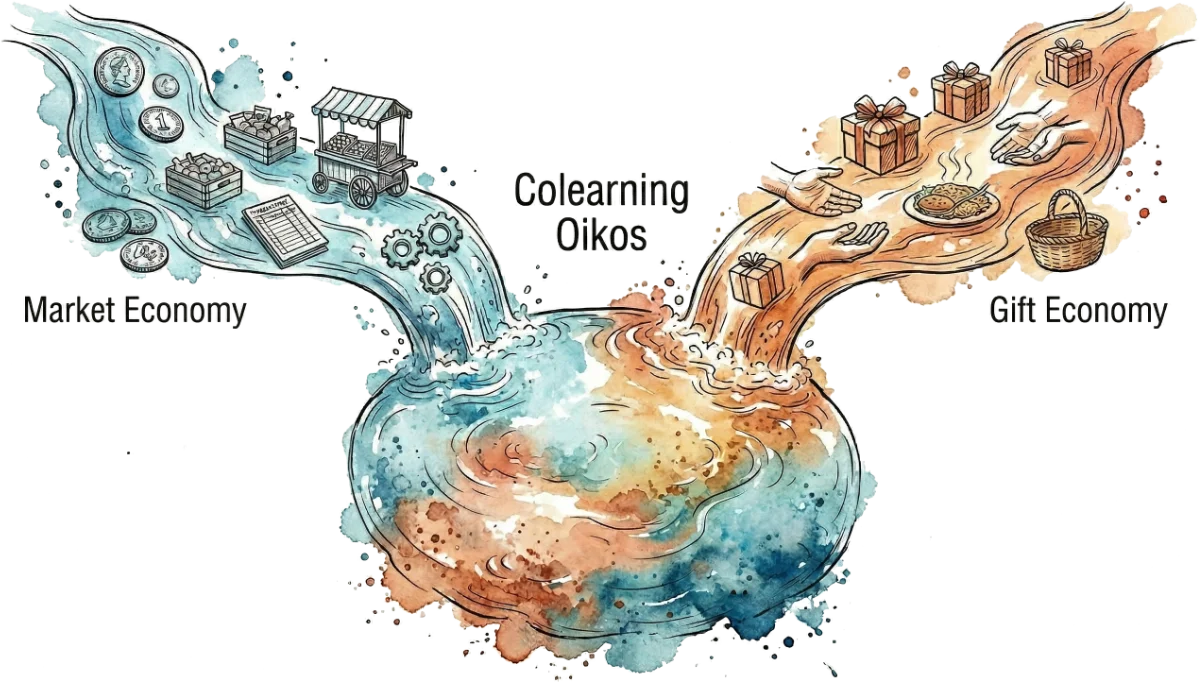
We distinguish two logics of the Oikos, which we consciously balance:
- In the Tribe (Inside), gift economy applies: Knowledge, tools, and care are shared. We don't account for every helping hand. The principle of reciprocity applies: "I give because I am part of the Tribe and because I know that the Tribe will carry me tomorrow if I need help."
- On the Hunt (Outside), market economy applies: The Tribe must survive. Therefore we leave the house to go on the "Hunt." There, at the interface with the outside world, we act (not only, but also) in market-economic terms. We found Learning Enterprises and sell goods and services. But the "Bounty" (the profit) flows back into the Tribe and strengthens its substance, instead of being privatized.
Security Through Sharing and Giving
Within the Tribe, security emerges not through individual accumulation of money or certificates, but through the dense web of mutual support. This approach connects to millennia-old traditions: In villages and tribal communities, surpluses were typically passed on, not sold. Anthropologists report that in such communities, goods circulate freely as gifts to strengthen social cohesion. Those who contribute and share gain respect, not those who hoard.
In Colearning, we don't measure success by the individual's bank balance, but by the quality of our relationships and by the resilience and beauty of the shared living space. A community that manages its own Oikos – that is capable of circulating food, energy, knowledge, and care locally – is incomparably more resilient in a volatile world ("Red World") than a collection of isolated consumers ("antifragile").
The Tribe gives us psychological safety. The Oikos of the Tribe gives us the economic basis ("I have enough"). Both belong inseparably together.
Further Reading & Sources
- Robin Wall Kimmerer: The Serviceberry (natural gift and exchange cycles).
- David Graeber: Debt: The First 5,000 Years (Gift economies / debt logic).
- Charles Eisenstein: Sacred Economics (Return to values of gift economy).
- Elinor Ostrom: What Grows When We Share (Commons economy).
- Marco Jakob: Insurance and Barn Raising of the Amish (Security through community).