
New Economy of Learning
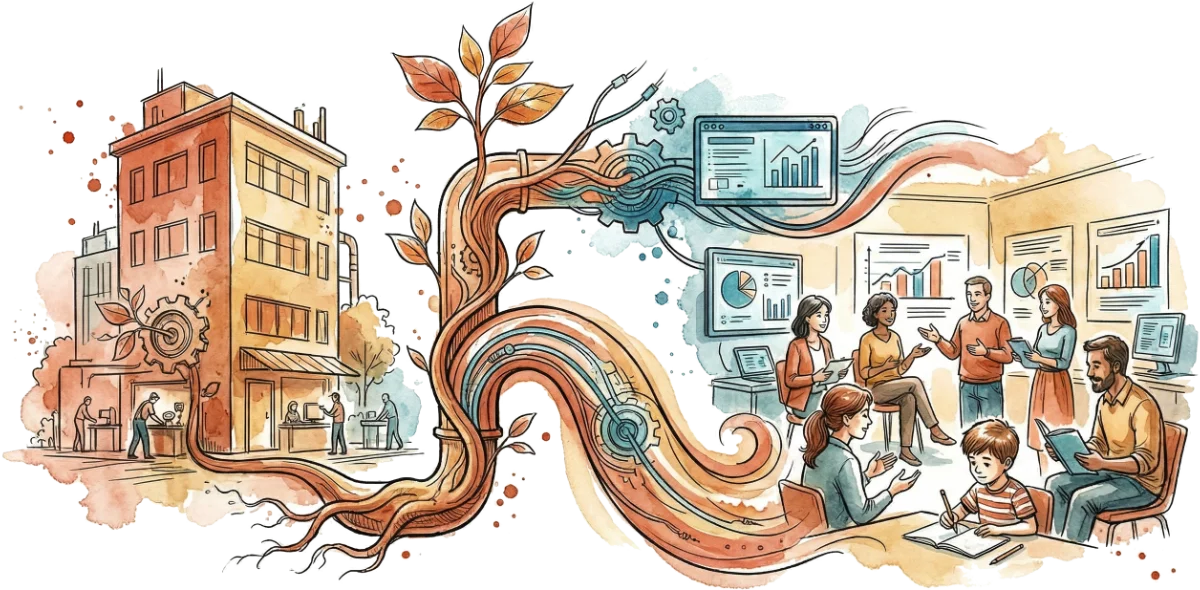
One of the most expensive inventions of the modern age was tearing learning out of its natural context. We have outsourced education into specialized pedagogical environments and replaced the real world there with simulations. To this day, this causes enormous costs for infrastructure, administration, and supervision. Moreover, this system requires a lot of energy for artificial motivation, for example in the form of grades. The higher the "red", complex share in the world becomes, the more inefficient this model of segregation proves to be. An isolated system becomes more expensive with every degree of external complexity in order to maintain the illusion of control.
Colearning radically reverses this logic. We no longer ask: "Who pays for the supervision?". Instead, our central question is: "How do we design an environment in which supervision as a separate service becomes obsolete?". By bringing learning back into the center of society and everyday life, we solve the artificially created cost problem of separation.
For Colearning to thrive, we need a suitable economic operating system. The classical education system often works extractively: It draws time, attention, and curiosity away to deliver standardized output – similar to the classical economy, which transforms raw materials and energy into output.
The Colearning economy, on the other hand, is based on regeneration. This means we want to leave systems and relationships more vibrant than we found them. A central lever for this is the clever use of resources that others consider "waste" or disruptive – be it the unused infrastructure in neighborhoods, the "waste heat" of real work processes, or supposedly unproductive free play. In this regenerative operating system, education transforms from an isolated cost factor into an integral component of local value creation.
Economic Anti-Patterns
A healthy Colearning economy must endure the tension between gift economy and market economy. If we blur these boundaries, either social sellout or financial ruin threatens.
| Anti-Pattern | Description | Check / Remedy |
|---|---|---|
| Mercenary | Uses the Tribe's resources (spaces, tools, expertise, network), but privatizes the gains and gives nothing back. | Check: Does "Bounty" (money/knowledge/etc.) flow back? Action: Look at the Tribe's psychological safety, live the culture of sharing and giving, "lift the veil." |
| Hobby Project | A project calls itself "Learning Enterprise," but has no customers and only burns the Tribe's resources without market reality. | Check: Is there an external invoice that someone pays? Action: Provide "end-of-life assistance" for the project or transfer it and stop calling it "Learning Enterprise." |
| Exploitation | Learning serves as a pretext for free labor, without those affected having a say or share in the success. | Check: Is radical autonomy preserved? Can those affected change the rules? Action: Participation according to Ostrom principles and transparent and fair sharing. |
| Speculator | A Learning Enterprise grows, but is ultimately sold for private gain ("Exit"). | Check: Clarify ownership structure. Is a sale for private advantage possible? Action: Anchor Steward Ownership (Asset Lock): The company belongs to itself. |
| Patriarch | Power and voting rights stick to people who are no longer operationally active (remote control). | Check: Do the active or the owning decide? Action: Anchor Steward Ownership (Self-Determination): Tie voting rights to active roles. |