
Self-Organization & Decisions
Organizing the Tribe and Distributing Responsibility
Colearning needs a structure that protects autonomy while guaranteeing agency and participation. We don't replace rigid hierarchies with chaos, but with decentralized self-organization. In doing so, we view our Tribe as a commons of knowledge, spaces, relationships, culture, and other resources. We nurture and manage this treasure together.
For the commons to thrive, we use Elinor Ostrom's design principles as guardrails:
- Clear Boundaries (Belonging): We clarify belonging to the Tribe through onboarding rituals and membership models. Whoever is part of the Tribe bears co-responsibility for the common whole.
- Adaptation to Local Conditions: Every Colearning is different. Rules are not dictated centrally but developed locally.
- Participation (We Make the Rules Ourselves): Those affected by the rules can change them. We use Sociocracy and consent decision-making for this:
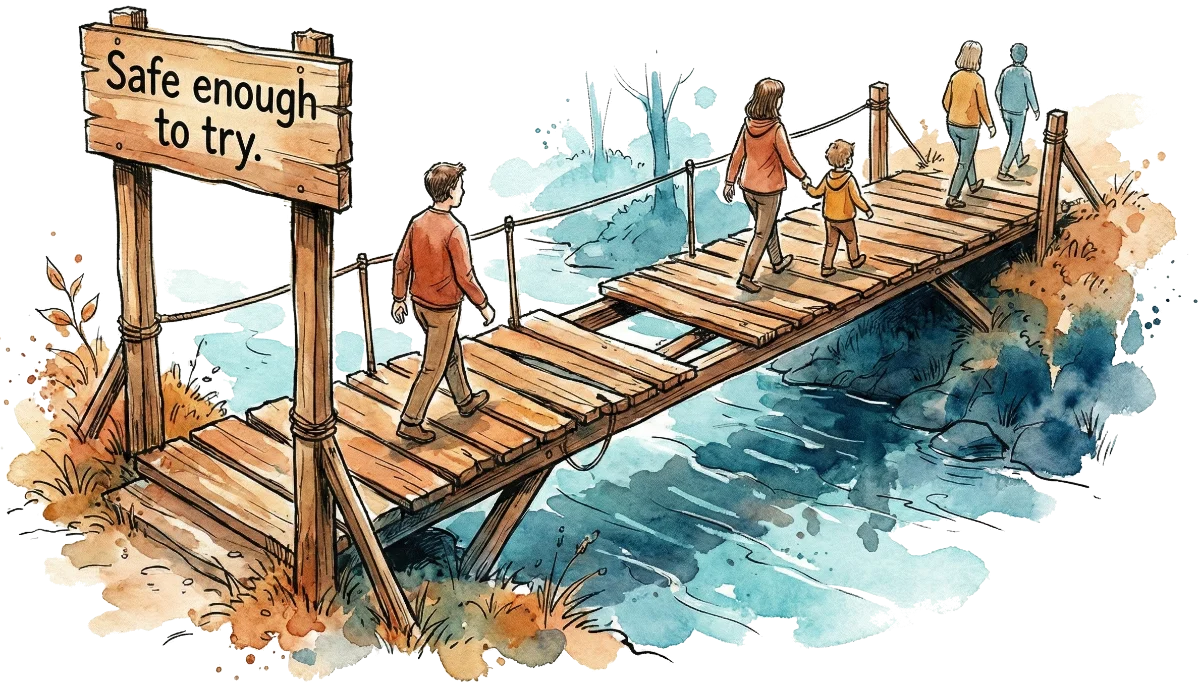
- A decision is considered made when there is no serious, substantiated objection ("Good enough for now, safe enough to try").
- This differs radically from majority decision (where minorities are outvoted) or from consensus (where one person can block everything).
- Monitoring (Social Visibility): Visibility and transparency are central. Compliance with agreements is ensured by the community itself. Since we work and learn "incidentally," we see each other. Violations are noticed.
- Graduated Resonance (Conflict Culture): When rules are violated, we respond early and with low threshold: perceive, address, clarify. When violations are repeated and serious, transparent, fair, and proportionate consequences apply. Conflicts are learning opportunities for us, not disruptions.
Democratic Co-Determination
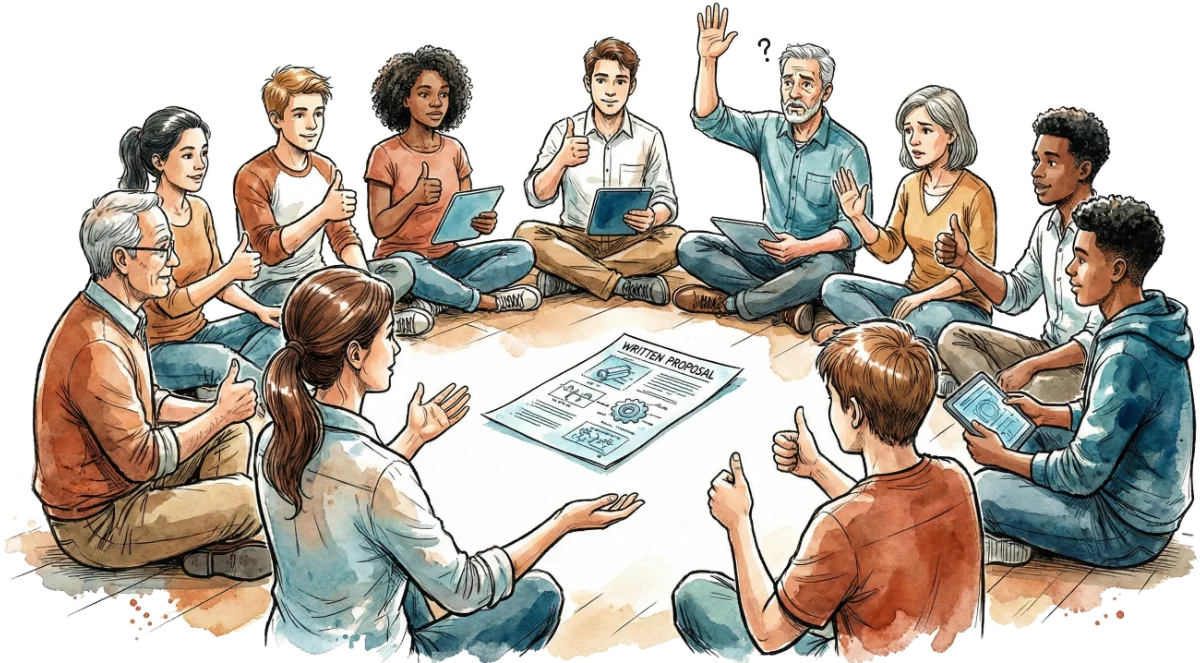
We let ourselves be inspired by original human social forms: Hunter-gatherer bands were mostly egalitarian, without chiefs ruling over the group. Decisions concerning the tribe were not dictated "from above," but discussed together until a solution was found that everyone could support. Anthropologists report that in these circles, every voice had weight – men and women, and often the children too. This participation of all is not a nostalgic ritual, but our operating system for effective cooperation: It ensures that no one is overlooked and that we find solutions together that actually work in everyday life and are supported by everyone.
In Colearning, we bring this principle into the modern era. Since we can't always discuss for days by the fire in a dynamic world, we use modern tools like Sociocracy. It preserves the spirit of direct participation: Every voice is heard, and decisions are made among equals. But instead of seeking the laborious consensus (everyone must agree), we ask for consent (does anyone have a serious objection that endangers the tribe's survival?). Thus we combine the wisdom of hunter-gatherers with the agency of modern organizations. As Peter Gray shows using the example of Sudbury Valley School, people learn responsibility not through obedience, but when their voice truly counts from the beginning.
Further Reading & Sources
- Elinor Ostrom: Governing the Commons (Logic of the commons).
- James Priest / Bernhard Bockelbrink: Sociocracy 3.0 (Decision-making by consent).
- Frederic Laloux: Reinventing Organizations (Concepts of self-management and wholeness).
- Peter Gray: Free to Learn. (Why genuine democracy is the natural social form of learning).
- Daniel Greenberg: Sudbury Valley School (a new view of learning).