
The Economy of the Incidental
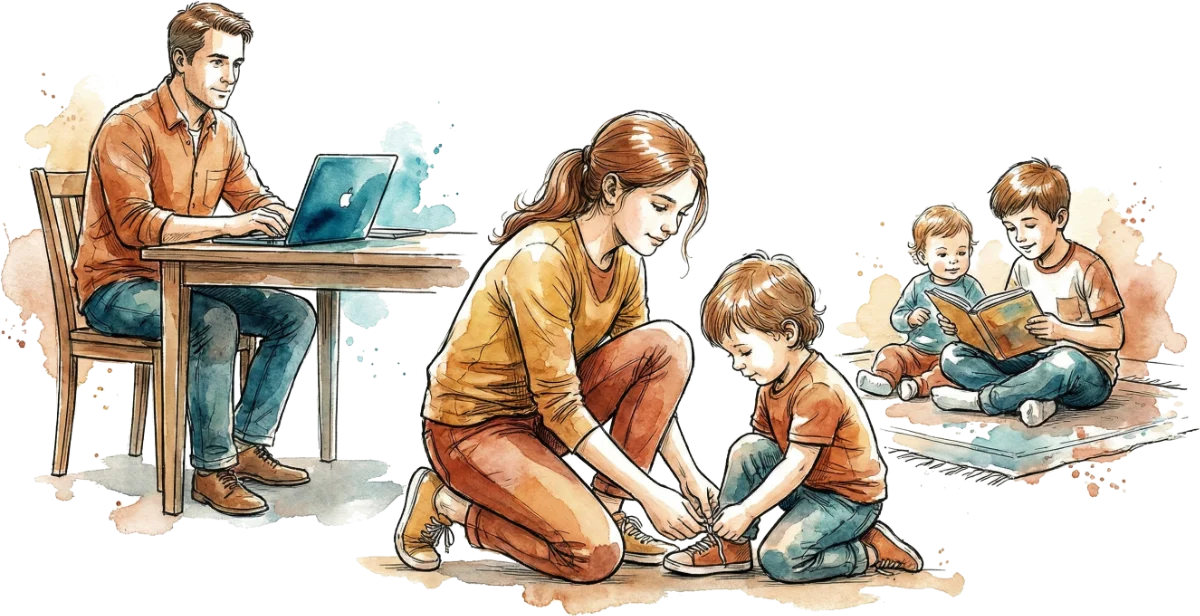
Why education becomes cheaper when it happens in the midst of life.
Colearning radically reduces education costs because learning is no longer produced as an isolated product, but emerges as a byproduct of real activity. Instead of building a learning world, we dock onto the world.
We thus use the "waste heat of real life": With every real activity (cooking, repairing, programming, selling, caring), knowledge, experience, and problem-solving competence arise. In the segregated world, this "waste heat" often dissipates behind closed doors.
Colearning plugs into these processes like a heat exchanger, thereby saving energy and costs:
- Age-Mixing (instead of supervision): In segregated age-grouped classes, paid supervision is needed. In a radically age-mixed community, the biological principle of allomothering (allo-parenting) kicks in: Older ones take responsibility for younger ones; knowledge and care flow organically in all directions. The need for professional entertainment and supervision decreases drastically the more mixed and stronger the community is.
- Incidental Learning (instead of simulation): In school, learning is the main product that must be laboriously produced with ever-greater effort. In Colearning, learning is an incidental byproduct of real activity. When we implement a project – whether cooking, repairing, or programming – learning happens along the way. We don't finance the simulation, but enable learning in reality.
- Infrastructure Sharing (instead of learning factories): We don't build monofunctional learning buildings. We dock onto places that already exist and where life is pulsing: workshops, offices, neighborhood centers, kitchens, coworking spaces. We use resources that often lie fallow, instead of building something isolated anew.
The Result: Traditional education systems become more expensive the higher the supervision ratio and the greater the mismatch to human nature and the complex world. Colearning becomes cheaper and more stable the denser and more diverse the relationships in the Tribe become. Colearning also doesn't suffer from the complexity of the world because it doesn't try to replicate the world, but goes into it and opens it up for learning.
And Colearning can also be categorized this way:
- Extractive (The Exhaustion of the Self): The subject views their talents as raw material that must be "mined" for degrees and careers. Learning feels like exploitation of one's own curiosity to meet expectations. In the end stands the certificate, but the inner enthusiasm is burned out.
- Sustainable (Self-Assertion): The subject learns resource-efficiently and tries to keep their own motivation stable. One learns only the minimum ("Just-in-Case") to not lose connection, while protecting one's own energy for "real life" outside of education.
- Regenerative (Resonance & Gift): The subject understands their own learning as a contribution to the viability of the whole. By making visible their own "Bounty" and "Learning Treasures" (Digital Garden, Treasure Sharing), they feed valuable insights back into the communal pool of experience. The subject grows by making the ecosystem (the Tribe) more fertile. Learning here is an act of generosity that multiplies the community's resources (knowledge, courage, inspiration) instead of just consuming them.
Further Reading & Sources
- Ivan Illich: Deschooling Society (Critique of the costs of institutionalization).
- Sarah Blaffer Hrdy: Mothers and Others (Concept of allomothering and cooperative breeding).
- Jean Lave & Etienne Wenger: Situated Learning (Learning as social practice, "Legitimate Peripheral Participation," "Communities of Practice").
- Marco Jakob: School in the Taylor Basin (Dynamic robustness / complexity).