
Regenerative Action
Beyond Sustainability
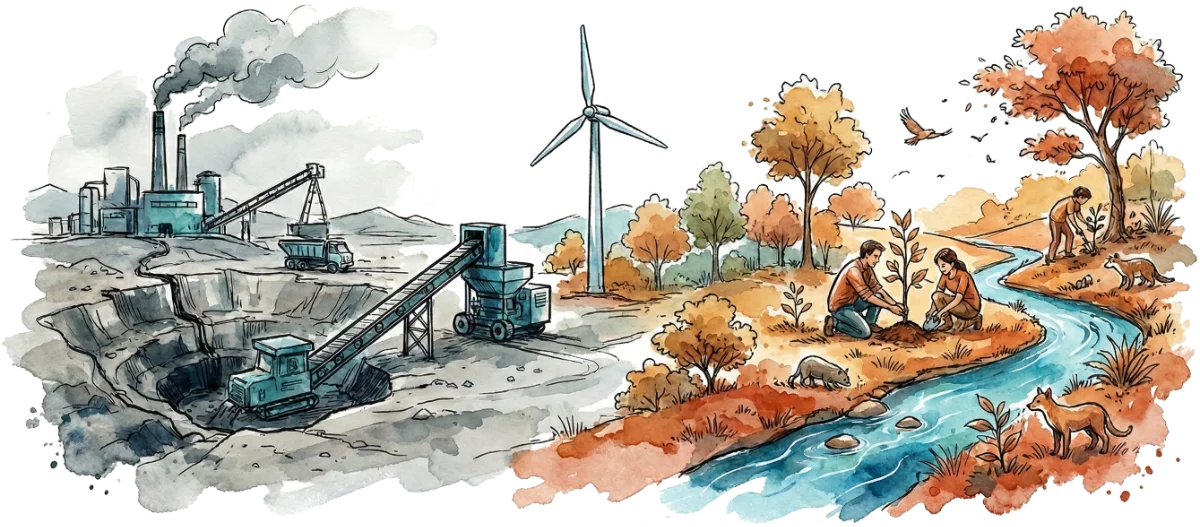
For a long time, "Sustainability" was the measure of all things. But the term is static. It literally means "to sustain." In a world where ecological and social systems are already deeply damaged, it's not enough to maintain the status quo or "do no further harm" (Net Zero). We strive for a regenerative economy.
- Extractive (Old Economy): We take resources and leave waste. The profit is private, the costs are borne by the public.
- Sustainable (Transition): We only take as much as regrows ("Net Zero"). We minimize our footprint.
- Regenerative (Colearning): We act as part of the ecosystem so that it becomes more fertile, resilient, and alive afterward ("Net Positive"). We leave a positive handprint.
The Serviceberry Economy
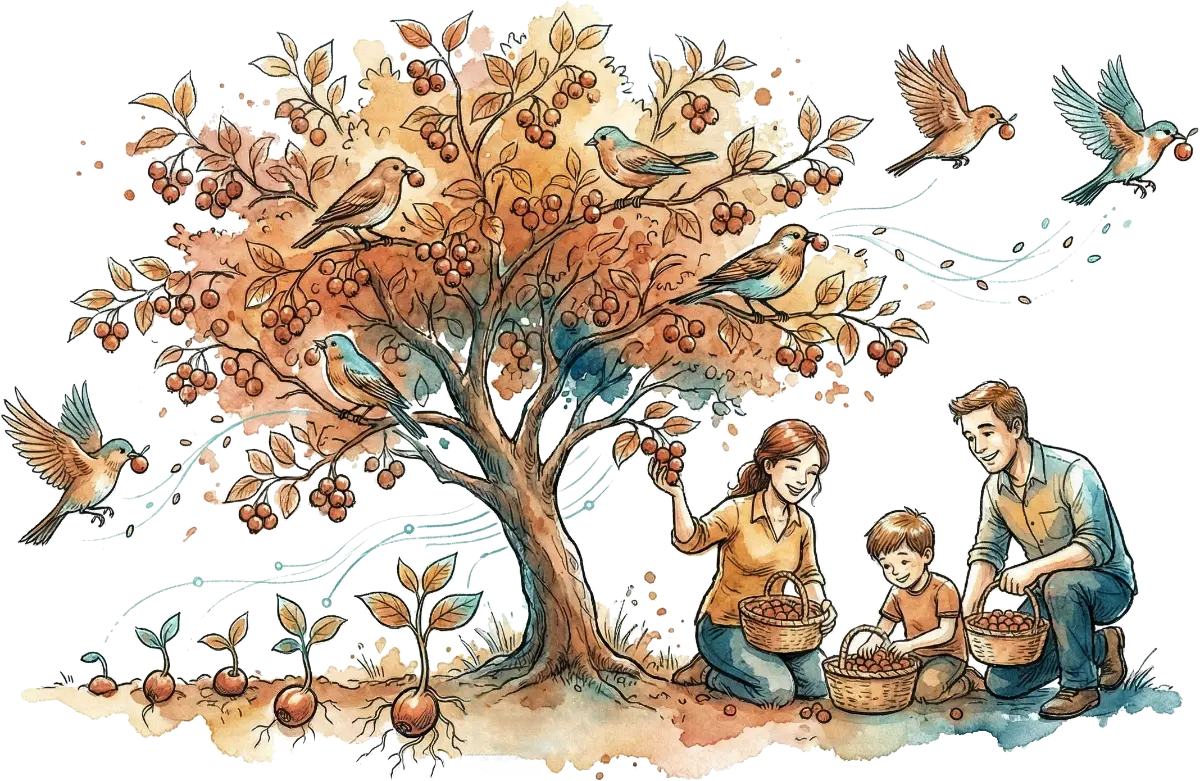
We learn from nature, inspired by the work of biologist Robin Wall Kimmerer on the Serviceberry. A tree doesn't hoard its fruits to increase their "value" through artificial scarcity. It gives them lavishly to the birds. This is not charity, but a survival strategy. The birds spread the seeds. The gift secures the tree's future better than keeping.
"Gifts consolidate the mystical recognition of participation in something greater than oneself."
(Charles Eisenstein)
Further Reading & Sources
- Robin Wall Kimmerer: The Serviceberry (natural gift and exchange cycles).
- Charles Eisenstein: Sacred Economics (Return to values of gift economy).
- Elinor Ostrom: What Grows When We Share (Commons economy).
- Kate Raworth: Doughnut Economics. (The concept of the safe and just space for humanity).