
HUNT: Doing & Responsibility
Core Statement: "I am needed."
The Hunt is the heart of competence development. During the Hunt, we leave the protected space of the Tribe and expose ourselves to reality. We simulate nothing. We work on real challenges, with real risk and real results.
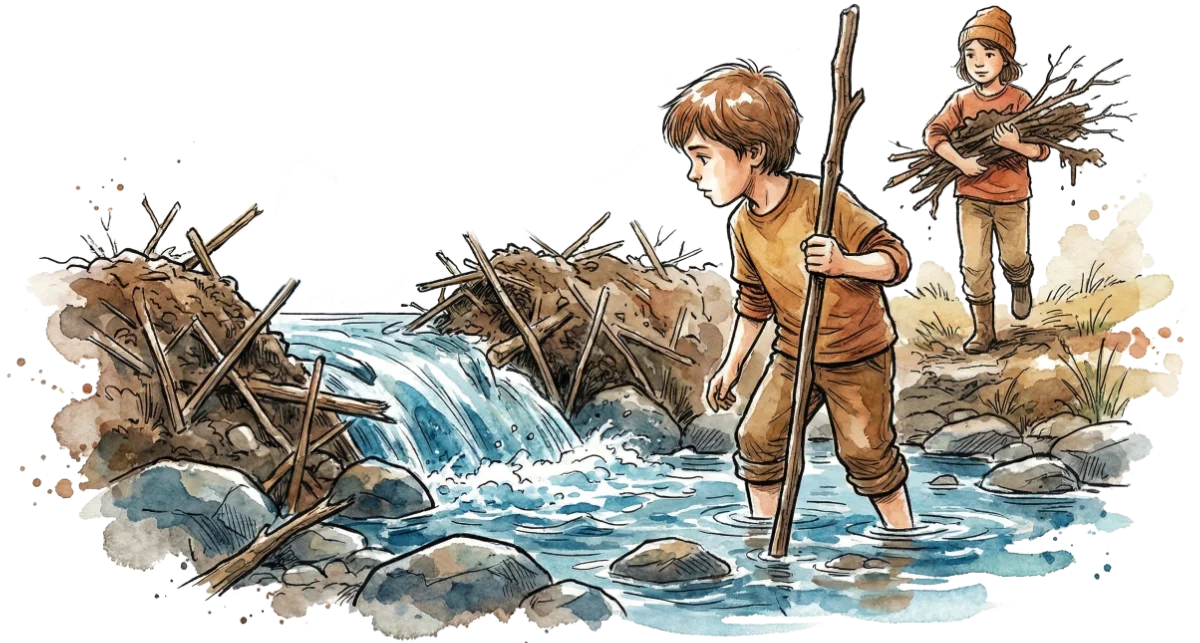
We don't distinguish between work and play. The Hunt is "serious play" (Deep Play). Whether a child builds a dam for hours or an adult opens a painting business: Both are in a state of highest concentration. Both take risks. Both want to achieve a result.
Learning is the inevitable consequence of doing.
Reality as Feedback
In artificial learning environments, mistakes are an abstract evaluation. In the Hunt, failure is a broken dam, an unsatisfied customer, or oversalted food. This feedback from reality is immediate and incorruptible. The Hunt produces two things:
- Bounty (success, yield, benefit) and
- Learning Treasures (insights from succeeding and failing).
Both are essential to becoming sovereign shapers. We don't learn here "just in case," but because the situation demands it (just-in-time).
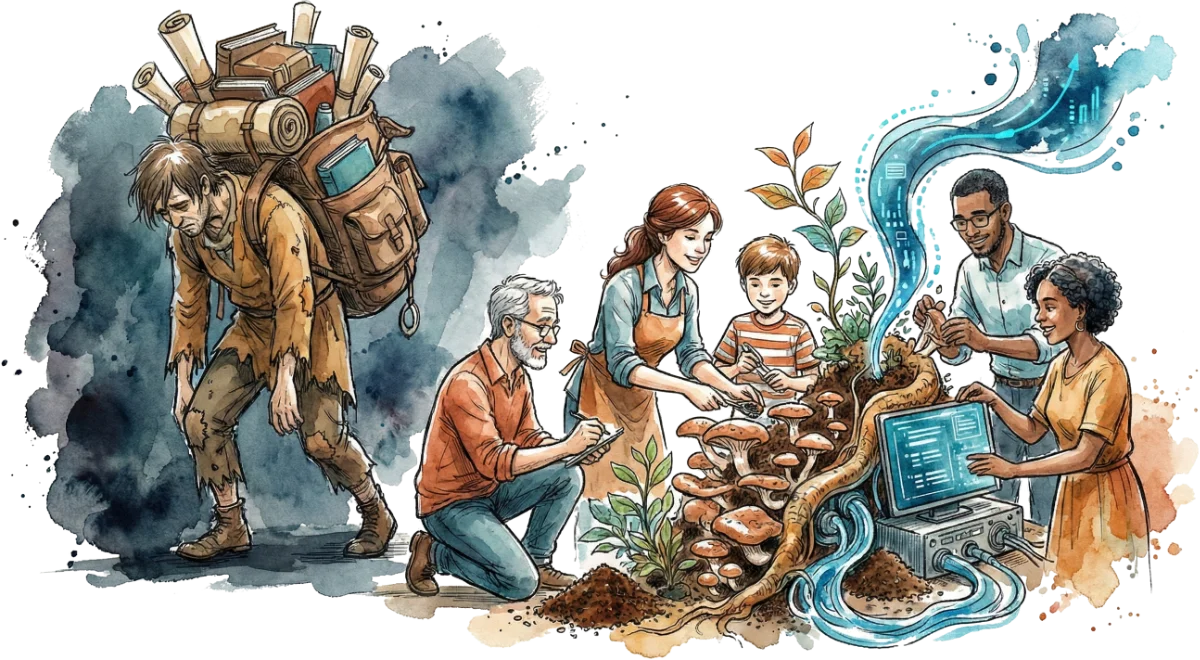
The End of the Backpack Metaphor: We must say goodbye to the idea that we can pack a "backpack full of knowledge" for children for life's journey. Knowledge is not provisions to be stored. In a digital world, the backpack is empty, because knowledge only emerges at the moment of application – as action, as networking, as access to information exactly when you need it. Those who try to carry supplies for an unpredictable journey only become slow and inflexible. We travel with light luggage and the ability to provide for ourselves on site.
Access before Efficiency
In the professional world, optimization often focuses on efficiency and maximum speed. This excludes learners. In Colearning, we reverse the logic: We consciously invest in accessibility. We don't pay experts to "play teacher," but to design their real work so that it becomes accessible to others. They make their processes and considerations visible and slow their pace where necessary so others can connect.
Legitimate Eavesdropping & Incidental Learning
Important actions and conversations often happen behind closed doors. In Colearning, we use the principle of legitimate eavesdropping: We conduct professional discussions, crisis conversations, or negotiations in open zones, and we enable "being nearby" when professionals are at work. This isn't always possible, or sometimes too dangerous. But when possible, we open the doors.
Learners pick up technical terms, tones, procedures, and problem-solving strategies from the air without being directly taught. This incidental learning transfers the implicit knowledge of a profession – that which cannot be explained, only experienced.
AI as Digital Accomplice
On the Hunt, AI is an active accomplice. It takes on roles currently missing in the project team: It's a sparring partner for strategies, supports rapid prototyping of code, or generates drafts. Colearners learn a new cultural technique: Leading AI so that it creates real value for the team.
The goal is not to outsource thinking, but to expand one's own capacity for action in the real situation. In an era with AI agents at the push of a button, confrontation with complex problems becomes an important resource for learning. There's little of that in standardized learning settings, and fortunately an abundance out there on the Hunt or during play in the real, wild world.
Typical Tools in the Hunt
- Learning Enterprise: This is our most important vehicle for the Hunt. We found real companies or start projects to link learning with economic reality. The Learning Enterprise provides the context for "seriousness."
- AI as Accomplice: We use generative AI tools directly in the work process to expand our capacity for action (see Futurability).
Anti-Patterns: When the Hunt Becomes an End in Itself
The Hunt needs real friction, but not destructive pressure.
| Anti-Pattern | Description | Check / Remedy |
|---|---|---|
| Sandbox | We only play "business." The money is play money and failure has no real consequences. | Check: Are there real consequences for failure? Action: Win external customers ("Accomplices") who make no allowances for "protected spaces." |
| Order Factory | Economic pressure becomes too great. Only efficiency and output count. Questions and learning are perceived as "disruptions" to operations. | Check: Are there weekly time windows for reflection? Does play happen? Action: Slow the pace and renegotiate the principle "Access before Efficiency." |
| Hero Mode | An experienced person (usually founders) takes over everything and secretly rescues projects before they fail. | Check: Are projects allowed to "crash against the wall" sometimes? Action: Practice consciously withholding rescue so learners can run their own projects. |
Further Reading & Sources
- Christoph Schmitt: Knowledge Doesn't Carry. And We Should Stop Lugging It. (Blog post on learnflow.city from 29.07.2025).
- Peter Gray: Free to Learn (The evolutionary perspective on why hunter-gatherers made no distinction between work and play, and why play is the serious case of learning for children).
- Mihaly Csikszentmihalyi: Flow (On the state of highest concentration and complete absorption in doing, which connects work and play).
- Diane Ackerman: Deep Play (An investigation of the human ability to connect playfully and intensely with the world – as a source of creativity and meaning).
- Nassim Nicholas Taleb: Antifragile & Skin in the Game (The concept that systems and people only learn when they take real risks and feel the consequences of their actions).
- Marco Jakob: School in the Taylor Basin.
- Gerhard Wohland: Thinking Tools for High Performers (Dynamic Robustness).
- Barbara Rogoff: The Cultural Nature of Human Development (Scientific foundation for LOPI – Learning by Observing and Pitching In – and how children learn through genuine participation).
- Paradise & Rogoff: Side by Side: Learning by Observing and Pitching In (Origins of the concept in hunter-gatherer cultures; they describe how in Peru or Mexico, adults deliberately tell stories when children are seemingly asleep or present).
- Jean Lave & Etienne Wenger: Situated Learning: Legitimate Peripheral Participation (The concept of learning by simply being present at the edge of a community).
- Ethan Mollick: Co-Intelligence (How artificial intelligence can be used as an active partner and accomplice in the work process).
- Marc Watkins: What Agency Means in the Era of Automation (A plea for human agency in a world of frictionless automation).
- Stefan Bauschard: Education Disrupted: Teaching and Learning in An AI World (Examination of radical AI acceleration challenging traditional educational paths and demanding reorientation toward volatile job markets and craft resilience).
- Nassim Nicholas Taleb: Antifragile (Skin in the Game and the necessity of stressors).